There are various legal entities that can give a legal framework to non-governmental organizations. In this context, identifying the relationship between a foundation and an NGO is important to know where the monthly donations you make to non-profit entities go.
Indeed, a nonprofit entity can take the form of associations or foundations. In both cases, these are legal entities established by the new Civil and Commercial Code of the Nation.
Because of its importance, below we detail the link between a foundation and an NGO. As a result, you will have all the information you need to ensure the highest level of security for each monthly donation you make.
1. An NGO can take the form of a foundation
In Argentina, nonprofit entities can acquire two types of legal status: civil association or foundation. As for the latter, according to art. 148 of the Civil and Commercial Code of the Nation (Law No. 26,994), it can be included as a private legal entity whose ultimate purpose is the common good.
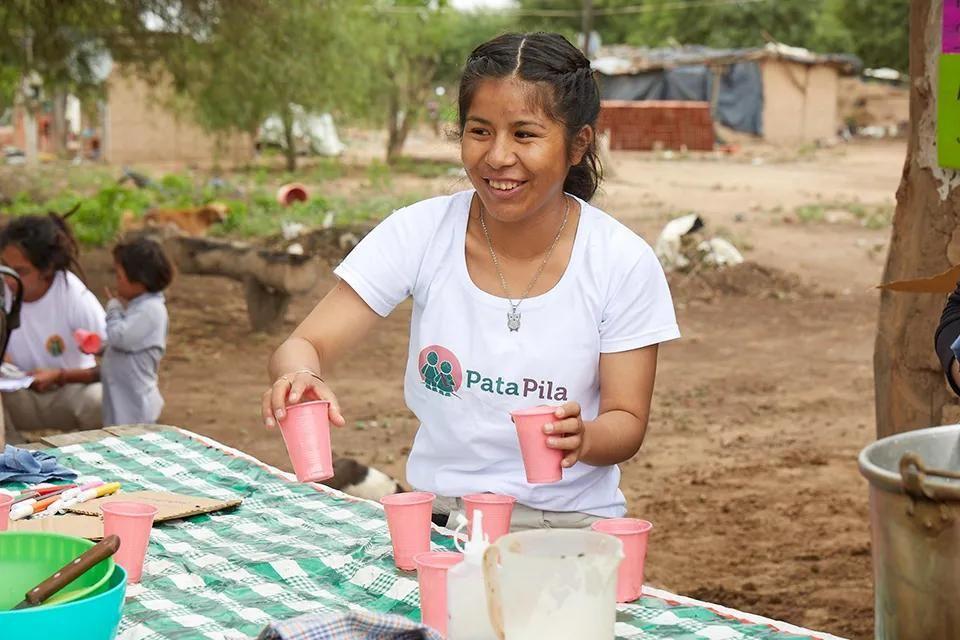
To distinguish between a foundation and an NGO, we can take the example of Pata Pila, our nonprofit entity, which is legally established as a civil association and not as a foundation.
However, as our founder Diego Bustamante states in an Infobae article, if you want to know how an NGO works, you should mention that the ultimate goal is social contribution:
"Solidarity depends on each one of us. It has a structure, a social investment effort with clear goals. My way of doing it is by getting involved with reality."
In this way, regardless of their organizational structure, all nonprofit institutions seek the common good and must always be legally regulated by the national State.
2. Every foundation and NGO requires state incorporation
Help us fight malnutrition!
So, regardless of the legal form a non-governmental organization adopts, its incorporation needs to be done through a public instrument.
Thus, any foundation and NGO must have authorization from the State. When doing so, the following items must be considered:
The importance of a notary public
Specifically, at the time of incorporation, it is necessary to go to a notary public to certify its creation and the corresponding registration with the Inspection of Legal Entities.
Establishing the activity plan
The social development program that will define the institution must be established. This is to verify the activities that will be carried out within the framework of the organization.
Declaration of the board of trustees
Another difference between an NGO and a foundation relates to the board of trustees. As a result of its incorporation, the founders or administrators will be responsible to third parties for the obligations they have taken on.
Declaration of the board of trustees
According to art. 193 of the Civil and Commercial Code of the Nation, to distinguish a foundation from an NGO, it should be highlighted that foundations aim at the pursuit of the common good. But through the contribution of assets by one or more people.
Unlike a non-profit NGO, which is made up of a group of people without profit motives, a foundation is created from the private initiative of one or more people, or of a business entity, to achieve social goals.
Taking this asset-based formation into account, it is essential to point out the following consequences:
- Foundations and NGOs are run by the people or companies that gave rise to the entity. From the foundational standpoint, an initial endowment is required to allow the declared activities to be carried out. This is indispensable for the institution to obtain State authorization to operate. In contrast, decisions in a non-profit NGO are made by the assembly that makes it up.
- Its financial upkeep is made possible by the contributions of all the founders, along with money contributions made by third parties or private institutions. Thus, funds are contributed by the members of the board of trustees. They are also supplemented by donations made by other people or private organizations.
In conclusion, by making a distinction between a foundation and an NGO, you can learn about the organizational structure to which each of your monthly donations is directed.
We invite you to be part of La Comunidad of Pata Pila, since 100% of the financial contributions raised come from individual donations.
Promoting the sustained development of the most vulnerable communities is possible.
Make your monthly donation. And as a result, the impact of all our work will also be your social impact.